
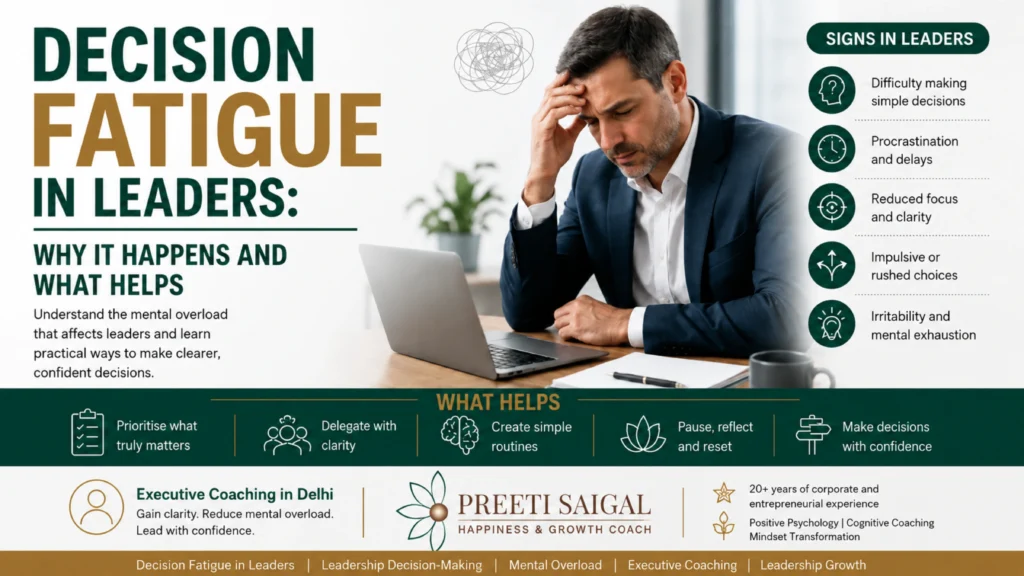
Leadership is often described in terms of vision, courage and judgment. What receives less attention is the volume of decisions behind those qualities. A business leader may begin the day thinking about growth, only to be pulled into hiring questions, pricing decisions, client concerns, team conflicts and operational approvals. By evening, even a relatively small choice can feel heavier than it should.
This is decision fatigue. It is not necessarily a sign of weak leadership or poor time management. More often, it reflects the cumulative effect of carrying too many decisions, too much responsibility and too much pressure to get every choice right.
What This Pattern Looks Like
Decision fatigue refers to the decline in decision quality after prolonged mental effort. In leadership roles, the signs are usually subtle: routine approvals take longer, strategic work is postponed, small issues trigger disproportionate irritation, or the same decision is revisited without producing greater clarity.
Sometimes leaders keep gathering information even when the issue is no longer a lack of data. At other times, they make a rushed choice simply to close the matter. A useful question is: is the decision genuinely complex, or have the thoughts and emotions surrounding it made it feel more complex?
Why Leaders Are Especially Vulnerable
Leaders move rapidly between financial, people, client and strategic questions, each requiring a different kind of thinking.
There is also the psychological weight of leadership. Many leaders feel they must anticipate every consequence, protect the business from error and remain visibly confident. This often creates familiar internal narratives:
- “I cannot afford to get this wrong.”
- “Everything depends on me.”
- “A strong leader should be certain.”
These beliefs can turn analysis into over-analysis and make delegation difficult. Leadership, however, does not require having all the answers; it requires making a responsible choice without complete certainty.
When the Leader Becomes the Bottleneck
Mental overload does not remain confined to the person at the top. When too many choices are escalated upwards, the leader becomes a bottleneck and the team becomes dependent. Execution slows, ownership weakens and employees learn to seek approval rather than exercise judgment.
Lack of delegation may reflect unclear decision rights, low trust, fear of mistakes or discomfort with giving up control. A useful distinction is to separate decisions into three categories:
- Decisions only the leader should make.
- Decisions requiring consultation but not final ownership.
- Decisions the team can make independently within agreed boundaries.
Clear approval limits and decision principles can reduce repetitive choices without reducing accountability.
The Hidden Thinking Patterns Behind the Overload
Leadership decisions are shaped not only by facts, but also by the meaning attached to them. A difficult client conversation may colour the next decision, while a past mistake may create excessive caution.
One common assumption is that a poor outcome proves the decision was poor. In reality, a sound choice can still lead to an unfavourable result because outcomes are influenced by variables no leader can fully control. The better test is whether the decision was thoughtful, evidence-based and consistent with the organisation’s priorities.
This allows leaders to treat outcomes as feedback rather than as a verdict on their competence.
What Helps Leaders Make Better Decisions
The first step is to define the desired outcome before comparing options. Instead of asking, “Which option should I choose?”, ask:
- What result am I trying to create?
- What matters most here?
- What information is essential rather than merely desirable?
- What level of risk is acceptable?
- What would a sufficiently sound decision look like?
It is equally important to separate facts from assumptions:
What do I know? What am I interpreting? What am I afraid may happen? What needs to be decided now?
This often reveals that the difficulty lies not only in the external situation, but also in the story being built around it.
Leaders can also protect their judgment by scheduling high-stakes decisions during periods of stronger mental energy, avoiding major choices immediately after emotionally charged conversations, and creating routines for repetitive decisions.
A Simple Decision Reset
When a decision feels stuck, work through six questions:
- What exactly needs to be decided?
- What outcome should the decision create?
- What facts, constraints and resources are available?
- Is the obstacle missing information, fear, perfectionism or concern about others’ reactions?
- What alternatives or smaller steps are available?
- What is the next responsible action, and by when?
This reduces the pressure to find the perfect answer and redirects attention towards making a considered decision with the information available.
How I Work With Leaders
For leaders exploring Executive Coaching in Delhi, my approach combines more than two decades of corporate and entrepreneurial experience with Positive Psychology and Cognitive Coaching. I do not tell leaders which decision to make. Instead, I help them examine the business context, recognise the assumptions and emotional patterns influencing their judgment, and identify a responsible way forward.
The purpose of coaching is not to remove uncertainty from leadership. It is to help leaders think more clearly within uncertainty, make decisions with greater awareness and avoid carrying choices that should sit elsewhere in the organisation.
Final Thoughts
Strong leadership does not require complete certainty. It requires the ability to make responsible decisions with the information available, accept that outcomes cannot be fully controlled and remain flexible enough to learn from what follows.
Once leaders distinguish what truly requires their attention, question the beliefs adding unnecessary pressure and create clearer structures for delegation and judgment, decision-making becomes lighter and more considered.
Frequently Asked Questions
Is decision fatigue the same as burnout?
No. It is linked specifically to sustained decision-making, although prolonged mental overload can contribute to burnout.
Can executive coaching improve decision-making?
Coaching can help leaders understand their decision patterns, separate facts from assumptions and clarify priorities.