
Author name: admin

career growth coach in delhi
Uncategorized

Career Growth When Hard Work Is Not Enough: A Practical Guide for Professionals

Most professionals begin their careers believing that consistent effort and good performance will naturally lead to growth. For a while, this may be true. Over time, however, many capable people reach a stage where hard work alone no longer seems to move their careers forward. They may be delivering well but remain overlooked, feel ready for leadership but struggle to establish influence, or find themselves uncertain about whether to stay, move or begin again. At such points, the problem is not always a lack of ambition or competence. It is often the absence of clarity about what needs to change next. This is where Career Growth Coaching can be valuableβ€”not as a source of generic motivation, but as a structured way to examine your goals, workplace reality, choices and patterns of behaviour. Begin by defining what growth means to you β€œCareer growth” can mean very different things to different people. For one professional, it may mean a promotion. For another, it may mean greater authority, more meaningful work, better compensation, a transition into leadership or a healthier way of working without constant exhaustion. Unless the desired outcome is clearly defined, it is difficult to create a useful plan. A question I often explore is: What would be visibly different in your professional life if you had made meaningful progress six months from now? Rather than saying, β€œI want to feel more confident,” describe what that confidence would look like in practice. Perhaps you would speak earlier in meetings, present your recommendations without excessive qualification, initiate a conversation about your role or take ownership of a larger assignment. Making a goal observable and specific helps the mind connect more strongly with it. It also gives you a clearer way to measure whether you are actually moving forward. Separate the situation from the story around it Career challenges are shaped both by what is happening and by how we interpret what is happening. A manager may not respond to an idea. That is the event. The internal story may be, β€œMy ideas are not valued,” β€œI am not senior enough to speak,” or β€œNothing will change here.” The story may be accurate, partially accurate or based on previous experiences that are influencing the present. This does not mean dismissing difficult workplace realities. It means separating facts from assumptions so that you can respond with greater choice. This distinction becomes especially important when managing up to a difficult boss. You may not be able to change another person’s behaviour, but you can become more deliberate about how you communicate, set expectations, document work and protect your professional position. Identify what is actually holding you back When professionals are not taking an action they know is important, the obstacle usually falls into one of three areas: a lack of skill, a lack of resources or an unhelpful mental state. A skill gap may require learning how to present to senior stakeholders, manage a team or hold difficult conversations. A resource gap may involve limited access to information, networks, time or organisational support. A mental-state barrier is different. You may know what to do and have the ability to do it, yet continue postponing the action because of fear, self-doubt, perfectionism, discomfort with visibility or concern about how others will respond. Each obstacle requires a different response. Skills can be developed, resources can often be arranged or worked around, while mental barriers need to be understood and addressed rather than disguised as poor time management. Expand your choices before making a major decision When people feel stuck, they often reduce the situation to two choices: stay or leave, speak up or remain silent, accept the role or reject it. In reality, there may be several options between these extremes. You might renegotiate part of your role, seek greater exposure through a cross-functional project, strengthen one capability before applying elsewhere, build a relationship with a potential sponsor, explore an adjacent role or test a new direction before committing fully. This is one of the strengths of the GROW approach used in Professional Development Coaching: clarify the goal, understand the current reality, generate options and decide what you are genuinely willing to do next. As I have written earlier, you will rarely have all the answers before you begin. Very often, clarity develops through movement. A small, informed experiment can teach you more than months of repeatedly analysing the same decision. Turn insight into behaviour Understanding why you are stuck is useful, but insight alone does not create career progress. The real change happens when a new response is practised consistently in the situations that previously triggered hesitation. One practical technique is to create an if-then statement that connects a predictable trigger with a more useful thought or action. For example: If I begin thinking that my point is not important enough, then I will share one clear recommendation in the meeting. Or: If I feel nervous before speaking to my manager, then I will return to the three facts I want to communicate. The replacement thought should be credible. Moving directly from β€œI am not capable” to β€œI am exceptionally confident” may create internal resistance. A smaller shiftβ€”such as β€œI may not know everything, but I understand this issue well enough to contribute”—is often more useful. Visibility is also part of career growth Many experienced professionals are uncomfortable drawing attention to their work. They believe that good performance should speak for itself. Unfortunately, organisations do not always work that way. Decision-makers cannot recognise contributions they do not fully see or understand. Visibility does not require constant self-promotion. It can mean communicating outcomes clearly, volunteering for relevant responsibilities, building relationships beyond your immediate team and helping stakeholders understand the value of your work. As explored in Good Work Isn’t Enough: Why Speaking Up Drives Career Growth, communicating your contribution is not separate from doing good work. At more senior levels, it becomes part of the work. Experience, context and the next stage of growth Career decisions

Career Growth When Hard Work Is Not Enough: A Practical Guide for Professionals Read Post Β»

Career Growth Coaching
Uncategorized

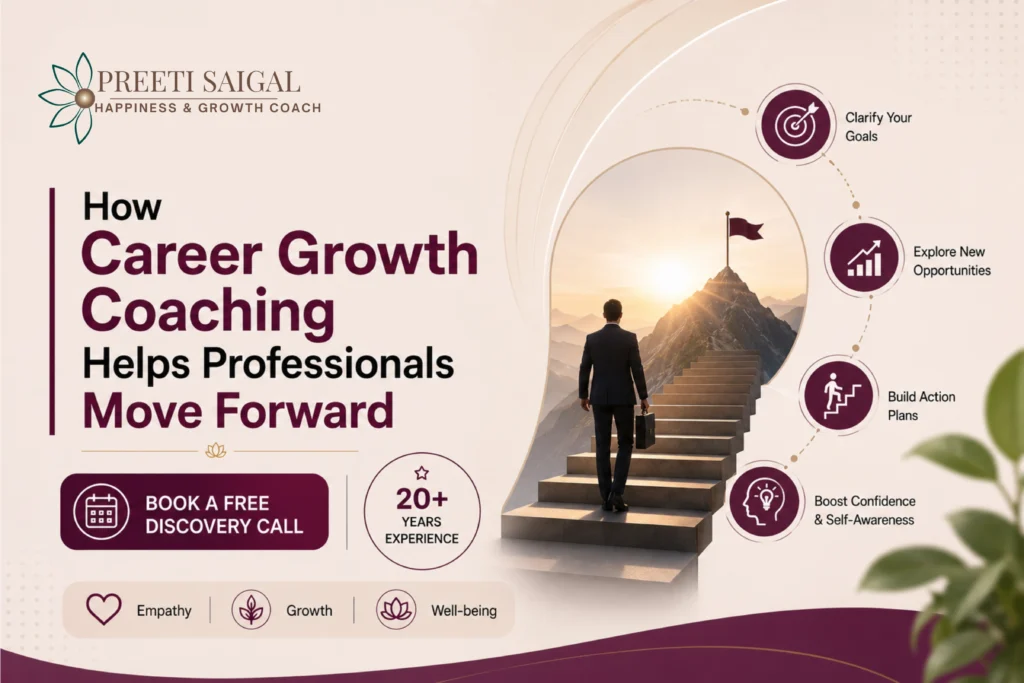
How Career Growth Coaching Helps Professionals Move Forward

There comes a point in many careers when working harder stops being the answer. You may still be performing well and seen as dependable, yet something feels stuck. Perhaps the promotion has not come, your responsibilities have increased without recognition, or the careeryou worked hard to build no longer feels as fulfilling as it once did. This is often when people begin considering Career Growth Coaching. For professionals looking for career growth coaching in Delhi, the need is rarely for another set of generic answers. More often, they need space to step back from day-to-day pressure, understand what is reallyhappening and decide what needs to change. Career growth does not mean the same thing for everyone We often speak about career growth as though it has one clear definition: a bigger title, a larger team or a higher salary. Yet growth may also mean preparing for leadership, becoming more visible, returning after a break, changing direction or setting healthier boundaries. Sometimes growth means moving up. At other times, it means moving sideways or changing how you show up at work. Career Growth Coaching helps you understand what progress means to you now, rather than continuing to chase an idea of success that no longer fits your life. Why capable professionals still feel stuck Capable professionals do not always feel stuck because they lack skill or effort. They may wait for someone to notice their contribution, avoid a difficult conversation, keep taking on more, or analyse every option until none feels safe enough to pursue. There is also a belief that good work will eventually speak for itself. Unfortunately, that is not always how workplaces operate. As I wrote in Good Work Isn’t Enough: Why Speaking Up Drives Career Growth, silence is often mistaken for satisfaction. Your manager may not know that you want a larger role, and the organisation may assume you are comfortable because you have never said otherwise. A career coach helps you notice these patterns without turning the conversation into self-blame. Once the pattern is visible, you can begin responding differently. What does a career coach actually help with? A career coach does not hand you a ready-made answer or push you towards a decision simply because it looks successful from the outside. The work helps you separate what is genuinely not working from the fear, frustration or expectations surrounding it. You may begin coaching convinced that you need to leave your job, only to realise that the real issue is a difficult manager, poor boundaries, lack of visibility or a role that has become too narrow. In another situation, you may recognise that you have outgrown the environment and are staying mainly because change feels risky. Career Growth Coaching gives you a structured way to examine the situation. What are you unhappy with? What do you want more of? What are you afraid of losing? Do you need a different role, or a different way of showing up in this one? A good coach will not answer these questions for you, but will help you explore them honestly and translate the answers into action. Turning reflection into practical action Reflection matters, but it can also become another form of delay. You may keep gathering opinions and still remain where you started. At some point, you have to move with the information you have. As I shared in You’ll Never Have All the Answers, clarity often comes after action rather than before it. This does not mean making a reckless decision. It means identifying a sensible next step that allows you to learn more. That step could be preparing for an honest conversation with your manager, taking on a more visible assignment, speaking to people in another industry, testing a side project or building a financial cushion before making a transition. Professional Development Coaching is most usefulwhen it turns β€œI want to grow” into action that is realistic within the context of your responsibilities and life. Building confidence and moving into leadership Confidence is often misunderstood as certainty. In reality, it develops when you act despite uncertainty and gradually learn that you can handle what follows. Career Advancement Coaching can support you as you prepare to ask for a promotion, express a point of view, negotiate responsibilities, set a boundary or make a decision that may not please everyone. The aim is not to make you louder, but to help you become clearer about whatyou want and more willing to communicate it. This becomes particularly important when you move from execution into leadership. Many professionals are promoted because they are excellent at getting things done, only to discover that management requires them to delegate, handle conflict and make decisions without complete information. Professionals exploring leadership coaching in Delhi or executive coaching in Delhi are often working through the shift from being a strong individual contributor to becoming a more conscious leader. Navigating a career change without romanticising it Career change is often presented as a brave leap towards more meaningful work. In reality, it can involve financial pressure, family responsibilities, questions of identity and the discomfort of becoming a beginner again. This is why career coaching must remain close to the reality of yourlife rather than pushing you towards dramatic action. A thoughtful transition may involve staying in your current role while you test another path, retrain or build a financial buffer. It may also reveal that you do not need an entirely new career; you may need a healthier role, a better environment or firmer boundaries. In Career Change at 40, I explore why the most important shift is sometimes not the career itself, but the pattern you keep carrying into it. There is rarely a completely risk-free option. The useful question is not which choice removes every difficulty, but which set of difficulties you understand and are prepared to work with. Moving forward with greater clarity Your career does not have to follow a perfect line to be meaningful. You may not know exactly

How Career Growth Coaching Helps Professionals Move Forward Read Post Β»

Why Am I Not Happy? 5 Signs You May Need Emotional Well-Being Coaching
Life Coach

Why Am I Not Happy? 5 Signs You May Need Emotional Well-Being Coaching

Why Am I Not Happy? 5 Signs You May Need Emotional Well-Being Coaching On paper, everything may look fine. You may have a stable career, a family, responsibilities, and a life that others may even describe as β€œgood.” And yet, somewhere inside, there may be a quiet question: Why am I not happy? Not broken. Not necessarily depressed. Just not light. Not fully present. Not connected to yourself in the way you want to be. This is more common than most people admit. Sometimes unhappiness does not come from one big crisis. It builds slowly through stress, emotional exhaustion, self-doubt, people-pleasing, over-responsibility, or years of living according to expectations that no longer feel like your own. This is where emotional well-being coaching can help. Not by giving you generic advice. Not by asking you to β€œthink positive.” But by helping you pause, understand your patterns, and create practical shifts in how you think, feel, respond, and live. Here are five signs that it may be time to seek support. 1. You feel unhappy even when nothing is really wrong This is one of the most confusing forms of unhappiness. Nothing major has collapsed. You may even feel guilty for feeling low because, technically, life is okay. But β€œokay” is not the same as emotionally fulfilled. Many people are functioning, achieving, and managing everything β€” but they are not flourishing. They have built the life they were supposed to build, but it does not feel the way they thought it would. A useful self-awareness exercise is to complete this sentence: I feel ______ about ______ when ______. For example: β€œI feel heavy about work when I think of Monday morning.” β€œI feel lonely when I cannot speak honestly.” β€œI feel restless when I imagine the next five years looking exactly like this.” This is often where self-awareness coaching begins β€” by helping you move from vague unhappiness to emotional clarity. Because until you name what you feel, you cannot work with it. You may also like reading: Meaning Lives in Context. 2. You are tired in a way sleep does not fix There is physical tiredness. And then there is emotional tiredness. Emotional tiredness often comes from carrying too much for too long β€” work pressure, family expectations, unspoken resentment, constant decision-making, or the need to be strong all the time. You may sleep, rest, take a break, or even go on a holiday and still feel drained. You may also notice that your mind refuses to settle. You are with family, but thinking about work. You are on a break, but checking messages. You finally have quiet time, but still feel restless. This is where stress and emotional health are closely connected. Emotional well-being coaching helps you understand what is draining you, what restores you, and what emotional load you may have normalised for too long. It is not about abandoning responsibility. It is about learning how to carry responsibility without abandoning yourself. 3. You keep overthinking, doubting yourself, or holding back Overthinking is often an attempt to protect yourself. You replay conversations because you do not want to be misunderstood. You imagine worst-case scenarios because uncertainty feels unsafe. You analyse other people’s behaviour because you are trying to feel in control. But after a point, overthinking stops helping and starts trapping you. A useful coaching question is: What story am I telling myself about this situation? For example: Event: Someone did not reply to your message.Story: They are upset with me.Emotion: Anxiety.Response: You withdraw, over-explain, or keep checking your phone. But what if the story changed? Maybe they are busy. Maybe they forgot. Maybe this is not about you. Maybe you can ask instead of assume. The same inner story can also affect your confidence. Low confidence does not always sound like β€œI can’t do this.” Sometimes it sounds like: β€œI should not ask for too much.” β€œLet me not say anything.” β€œWhat if they think I am difficult?” Many capable people keep waiting to feel confident before they act. But confidence often comes after action, not before. Sometimes emotional balance begins when we stop treating every thought as a fact. If this connects with your career experience, you may also find this useful: Good Work Isn’t Enough: Why Speaking Up Drives Career Growth. 4. Your relationships are being affected, and you keep putting yourself last When we are emotionally overwhelmed, it rarely stays inside. It shows up in how we speak, withdraw, react, assume, over-explain, or silently resent. Many relationship struggles are not only about communication. They are about the emotions sitting underneath the communication. Anger may be covering hurt.Silence may be covering fear.Control may be covering insecurity.Distance may be covering exhaustion.People-pleasing may be covering the fear of rejection. At the same time, many people are praised for adjusting, managing everything, being strong, and not making a fuss. But constantly putting yourself last comes at a cost. You may begin to feel resentful, invisible, exhausted, or disconnected from your own needs. And then you may judge yourself for feeling that way. The better question is not, β€œWhy am I so selfish?” The better question is: Where have I been abandoning myself while trying to be good to everyone else? If you are wondering how to find happiness within, this is one part of the answer: Stop treating your emotional needs as an inconvenience. An emotional healing coach can help you notice these patterns without blame, so you can respond instead of react, set healthier boundaries, and communicate with more clarity. For a related reflection, read: Mindfulness in Marriage: When Love Starts Feeling Like Exhaustion. 5. You know something needs to change, but you do not know where to start This is where many people get stuck. They know they want more peace, clarity, confidence, or purpose. But everything feels too tangled. Should I change my career?Should I work on my relationship?Should I take a break?Should I be more disciplined?Should I just be grateful? When everything feels connected,

Why Am I Not Happy? 5 Signs You May Need Emotional Well-Being Coaching Read Post Β»

Uncategorized

Career Choices After 40: Do You Want toStay, Shift, or Start Again?

Career & Life Transitions Career Choices After 40: Do You Want to Stay, Shift, or Start Again? Something changes after forty. Not always suddenly. Not always dramatically. But many people begin to ask more honest questions about work. Earlier, the focus may have been growth, money, stability, recognition, or proving yourself. But after forty, the questions often become more personal. “Is this still meaningful to me?”“Do I want to keep doing this for the next 15 or 20 years?”“Am I staying because this still fits, or because change feels risky?” This is why a career change at 40 is not always about leaving everything behind. Sometimes it is about changing how you work. Sometimes it is about shifting direction. Sometimes it is about starting something new. And sometimes it is about staying where you are, but in a healthier and more conscious way. The real question is not always, “Should I quit?” The better question is, “What choices do I actually have?” What happens after 40? By forty, many people have enough experience to know that success on paper does not always mean fulfilment inside. You may have a stable job, a good income, a respectable role, and years of experience. Yet something may still feel off. Maybe the work no longer challenges you.Maybe the culture drains you.Maybe you want more flexibility.Maybe you want more meaning.Maybe you are tired of carrying responsibility without enough joy. Or maybe nothing is obviously “wrong”, but inside, you know this version of success no longer feels complete. That does not mean your earlier choices were wrong. They may have been right for who you were then. But they may not fully fit who you are now. 1. Stay, but change how you work Sometimes you do not need a new career. You need a new relationship with your current career. This may mean setting better boundaries, speaking up more clearly, asking for a role change, changing teams, reducing unnecessary responsibility, or no longer making yourself available for everything. This option works when the career still has value, but the way you are functioning within it has become unhealthy. The difficulty is that it requires you to change old patterns. You may need to stop over-functioning.You may need to say no.You may need to ask for support.You may need to tolerate disappointing people. That is not easy, especially if your identity has been built around being capable, dependable, and always available. But sometimes the career does not need to change first. The pattern does. If this feels familiar, you may also find this useful: Good Work Isn’t Enough: Why Speaking Up Drives Career Growth. 2. Shift into an adjacent path Sometimes changing careers at 40 does not mean starting from zero. It means repositioning what you already know. You may move from HR into coaching or organisational development.From teaching into training or content creation.From operations into consulting.From sales into client strategy.From corporate work into advisory or freelance work. This kind of career transition at 40 allows you to carry your existing strengths into a new space. The difficulty is self-doubt. You may wonder, “Am I qualified enough?” or “Will people take me seriously?” But you may already have transferable skills β€” communication, problem-solving, leadership, planning, client management, emotional maturity, and judgement. The work is not to erase your past. The work is to reframe it. 3. Start something of your own For some people, the next chapter may be entrepreneurship, consulting, coaching, freelancing, or building an independent practice. This can feel exciting because it gives you autonomy and ownership. But it also brings uncertainty. You may need to learn marketing, selling, pricing, networking, technology, and how to stay steady when results are slow. The challenge is not only professional. It is emotional. Can you stay confident without immediate validation?Can you keep showing up while still learning?Can you treat feedback as information, not failure? This option should not be romanticised. But it should not be dismissed either. Start small. Test the idea. Speak to people. Offer a pilot. Build proof. Learn what the market actually values. A thoughtful experiment is often better than a dramatic leap. 4. Retrain for something new Sometimes the desire is for a deeper change. You may want to move into counselling, wellness, teaching, writing, design, healthcare, technology, social work, or another field that requires learning. A career change at 40 with no experience can feel intimidating. But “no experience” usually means no direct experience in that field. It does not mean you have nothing to offer. You bring maturity, discipline, perspective, communication, resilience, and life experience. The difficulty here is patience. You may need a course, certification, supervised practice, portfolio, or a gradual transition. You may have to become a beginner again in some areas. That can be uncomfortable. But it can also be freeing. 5. Build a parallel path first This is often the most practical way to start a new career at 40. You do not leave everything immediately. You start building the next chapter alongside your current life. You take a course.You speak to people in the field.You volunteer or consult part-time.You create a portfolio.You test your interest in real life. This reduces risk because it gives you information before you make a big decision. The difficulty is energy. You may already be tired. So the aim is not to do everything at once. The aim is to build momentum without burning yourself out. You do not need to have every answer before you begin. Sometimes you only need enough clarity to take the next step. I have written more about that here: You’ll Never Have All the Answers. Every choice has a cost People often stay stuck because they are waiting for a risk-free option. But there may not be one. If you stay, the cost may be regret.If you leave, the cost may be uncertainty.If you pivot, the cost may be discomfort.If you start again, the cost may be time.If you build slowly, the cost

Career Choices After 40: Do You Want toStay, Shift, or Start Again? Read Post Β»

Preeti Saigal
🌟 Discovery call booked just now preetisaigal.com
Preeti
Harmony Clarity Concierge Β· Preeti Saigal
✨ Discovery Call

Grow With Clarity & Confidence

Happiness & Growth Coach | Life & Career Strategy | 20+ years exp.

🎯 Clarity πŸ’› Balance πŸš€ Growth

Confidential & no-obligation

You're All Set! 🌸

Preeti's team will reach out within 24 hours. You've taken a beautiful step forward.

Scroll to Top