
Have you ever met someone who has a good career, a supportive family, and many opportunities, yet still feels stuck?
Maybe they know they want a change but cannot figure out where to start. Maybe they have a dream but lack the confidence to pursue it. This is where a life coach can make a meaningful difference.
With more people looking for clarity, confidence, better relationships, career direction, and personal growth, life coaching is becoming an increasingly popular career choice in India.
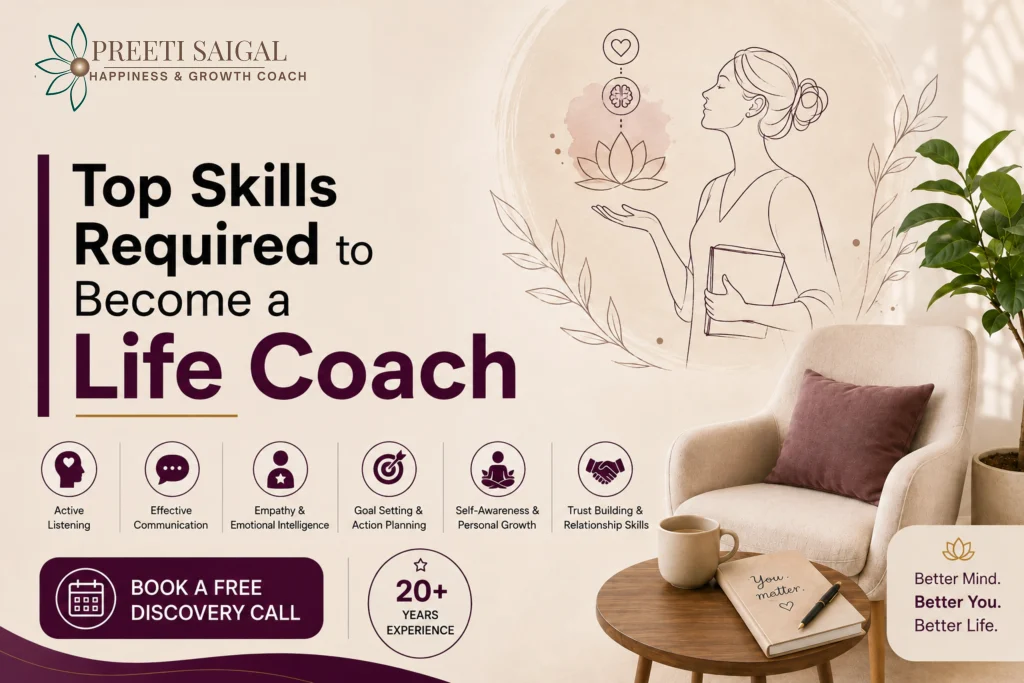
If you are wondering how to become a life coach, developing the right skills is the first step. A successful life coach is not simply someone who gives advice. A coach listens, asks the right questions, helps people discover their strengths, and supports them in turning goals into action.
In this guide, let’s explore the top skills required to become a life coach and how you can develop them with the right training and guidance.
Why Is Life Coaching Becoming a Popular Career?
Imagine a young professional who has spent years building a career but suddenly feels unsure about the next step. They are not necessarily looking for someone to tell them what to do.
They need someone who can help them understand what they truly want. This is one of the reasons people seek life coaching.
Today, individuals are looking for support with:
- Career growth and professional decisions
- Confidence and self-development
- Goal setting and motivation
- Work-life balance
- Personal relationships
- Leadership and communication
- Finding clarity and direction
As awareness of coaching continues to grow, more people are exploring how to become a certified life coach and turn their passion for helping others into a meaningful profession.
1. Strong Communication Skills
A life coach spends a significant amount of time communicating with people from different backgrounds.
But good communication is not just about speaking confidently. A professional life coach should know how to:
- Express ideas clearly
- Ask meaningful and powerful questions
- Communicate without judging
- Understand verbal and non-verbal cues
- Create comfortable conversations
For example, instead of telling a client, “You should change your career,” a coach may ask questions that help the client understand why they feel dissatisfied and what they actually want.
That ability to guide a conversation is one of the most important skills required to become a life coach.
2. Active Listening and Empathy
Sometimes, people don’t need immediate solutions. They simply need someone who genuinely listens.
Active listening allows a coach to understand not only what a client says but also what may be behind their words.
Empathy helps a coach:
- Understand different perspectives
- Build trust
- Recognize emotional barriers
- Create a safe coaching environment
- Make clients feel heard and understood
A good coach doesn’t judge the client’s choices. Instead, they help the client look at their situation from a clearer perspective.
3. Goal Setting and Action Planning
Many people have goals but struggle to turn them into reality. Someone may say:
“I want to become more confident.”
But what does confidence actually look like in their daily life?
A life coach can help transform a broad goal into smaller, measurable actions. This may include identifying obstacles, setting priorities, creating timelines, and reviewing progress.
Strong goal-setting skills help coaches move clients from “I want to change” to “I know what I need to do next.”
4. Powerful Questioning Skills
One of the most valuable skills in coaching is knowing what to ask.
Instead of giving clients ready-made answers, a coach uses thoughtful questions to encourage self-reflection.
Questions such as
- What is stopping you from taking the next step?
- What would you choose if fear wasn’t holding you back?
- What does success mean to you?
- What is one thing you can change this week? can help clients discover answers within themselves.
This is what makes coaching different from simply giving advice.
5. Emotional Intelligence
Life coaching involves working with people, emotions, expectations, and personal challenges.
Emotional intelligence helps a coach recognize and manage their own emotions while understanding what a client may be experiencing.
A life coach with strong emotional intelligence can:
- Respond calmly during difficult conversations
- Recognize emotional patterns
- Build stronger relationships
- Communicate with sensitivity
- Help clients become more self-aware
Developing emotional intelligence is therefore an important part of becoming a confident and effective coach.
6. Confidence and Leadership Skills
Imagine entering a coaching session and speaking to someone who is struggling with an important decision.
The coach needs to create an environment where the client feels supported while also maintaining professionalism.
Confidence helps a coach communicate with clarity, while leadership helps them positively influence and guide clients.
These skills can help you:
- Conduct professional coaching sessions
- Build credibility
- Motivate clients
- Handle challenging conversations
- Develop your coaching identity
7. Problem-Solving and Critical Thinking
Every client is different.
One person may be struggling with career confusion, while another may be dealing with lack of confidence or difficulty achieving personal goals.
A life coach needs to understand the situation rather than immediately applying the same solution to everyone.
Problem-solving skills help coaches:
- Identify challenges
- Understand possible barriers
- Explore different perspectives
- Develop practical action steps
- Help clients make informed decisions
The goal isn’t to solve every problem for the client but to help them develop the ability to approach challenges more effectively.
8. Self-Awareness and Continuous Learning
Before helping others understand themselves, a coach should also be willing to understand themselves.
Self-awareness allows coaches to recognize their own beliefs, assumptions, strengths, and limitations.
A professional life coach should continue learning through:
- Coaching education
- Workshops and training
- Practical experience
- Mentorship
- Self-reflection
- Reading and professional development
The coaching profession continues to evolve, making lifelong learning an important part of a successful career.
9. Personal Branding and Marketing
Being a skilled coach is only one part of building a coaching career.
People also need to know who you are, what you offer, and how you can help them. Personal branding can help you establish your presence as a coach through:
- Social media content
- Educational videos
- Blogs and articles
- Workshops and webinars
- Client-focused content
- Professional networking
For aspiring coaches, learning how to communicate their expertise online can be just as important as developing coaching skills.
A Story of Transformation: From Feeling Stuck to Finding Direction
Consider someone named Riya.
She had a stable job and was doing reasonably well professionally. From the outside, everything seemed fine. But every evening, she found herself asking the same question:
“Is this really what I want to do with my life?”
She had ideas but couldn’t decide which direction to take. She was afraid of making the wrong choice and kept postponing important decisions.
Instead of telling Riya what career she should choose, a life coach helped her explore her values, strengths, fears, and priorities.
Through meaningful conversations and structured goal-setting, Riya gradually became clearer about what she wanted.
The biggest change wasn’t that someone gave her an answer.
She discovered the answer herself.
That is the real value of life coaching.
How to Become a Life Coach with Preeti Saigal
If you are passionate about helping people grow, becoming a life coach can be a fulfilling career path.
Preeti Saigal focuses on helping individuals work towards personal growth, confidence, clarity, and meaningful change.
With the right guidance and practical learning, aspiring coaches can develop essential skills such as
- Effective communication
- Active listening
- Goal-setting
- Emotional intelligence
- Coaching techniques
- Confidence building
- Leadership
- Personal branding
Whether you are exploring how to become a life coach, looking for life coach certification in Delhi NCR, or considering an online life coaching course, structured training can help you develop the foundation required to begin your coaching journey.
Who Can Become a Life Coach?
You don’t necessarily need to come from one specific professional background to explore life coaching.
People from different careers and experiences may choose coaching because they enjoy:
- Helping others
- Listening to people’s concerns
- Motivating and supporting others
- Personal development
- Communication and leadership
- Guiding people towards their goals
What matters is the willingness to learn professional coaching skills and continuously improve.
Why Choose Preeti Saigal for Life Coaching Training?
Learning life coaching is not just about understanding theories. It is about learning how to work with real people and real-life situations.
Training with Preeti Saigal can help aspiring coaches develop practical coaching abilities while building greater confidence in their communication, goal-setting, leadership, and personal growth skills.
The objective is to help you move from simply wanting to become a coach to developing the skills and confidence required to build your coaching journey.
Conclusion
Becoming a successful life coach requires much more than the desire to help people.
You need strong communication, active listening, empathy, emotional intelligence, goal-setting, questioning, problem-solving, confidence, and continuous learning.
Most importantly, a life coach should understand that every person’s journey is different.
Sometimes, the most powerful transformation begins with one honest conversation and one important question.
If you are exploring how to become a certified life coach and want to build a meaningful career helping others, developing these skills can be your first step.
With the right training, mentorship, and consistent practice, you can turn your interest in personal growth into a professional coaching journey with Preeti Saigal.
Frequently Asked Questions
What are the top skills required to become a life coach?
The key skills include communication, active listening, empathy, emotional intelligence, powerful questioning, goal-setting, problem-solving, confidence, and leadership.
How can I become a certified life coach?
You can start by enrolling in a structured life coaching training or certification program that teaches professional coaching techniques, communication, goal-setting, and practical coaching skills.
Where can I get life coach certification in Delhi NCR?
Aspiring coaches can explore professional life coaching training and certification programs in Delhi NCR, including programs offered through experienced coaches such as Preeti Saigal.
Is an online life coaching course effective?
Yes. A well-structured online life coaching course can provide theoretical knowledge, coaching frameworks, demonstrations, and opportunities to practice coaching skills. The quality and practical component of the program are important factors to consider.
Can anyone become a life coach?
People from different educational and professional backgrounds can explore life coaching. However, proper training, practical experience, self-awareness, and professional development are important for becoming an effective coach.