Career & Life Transitions
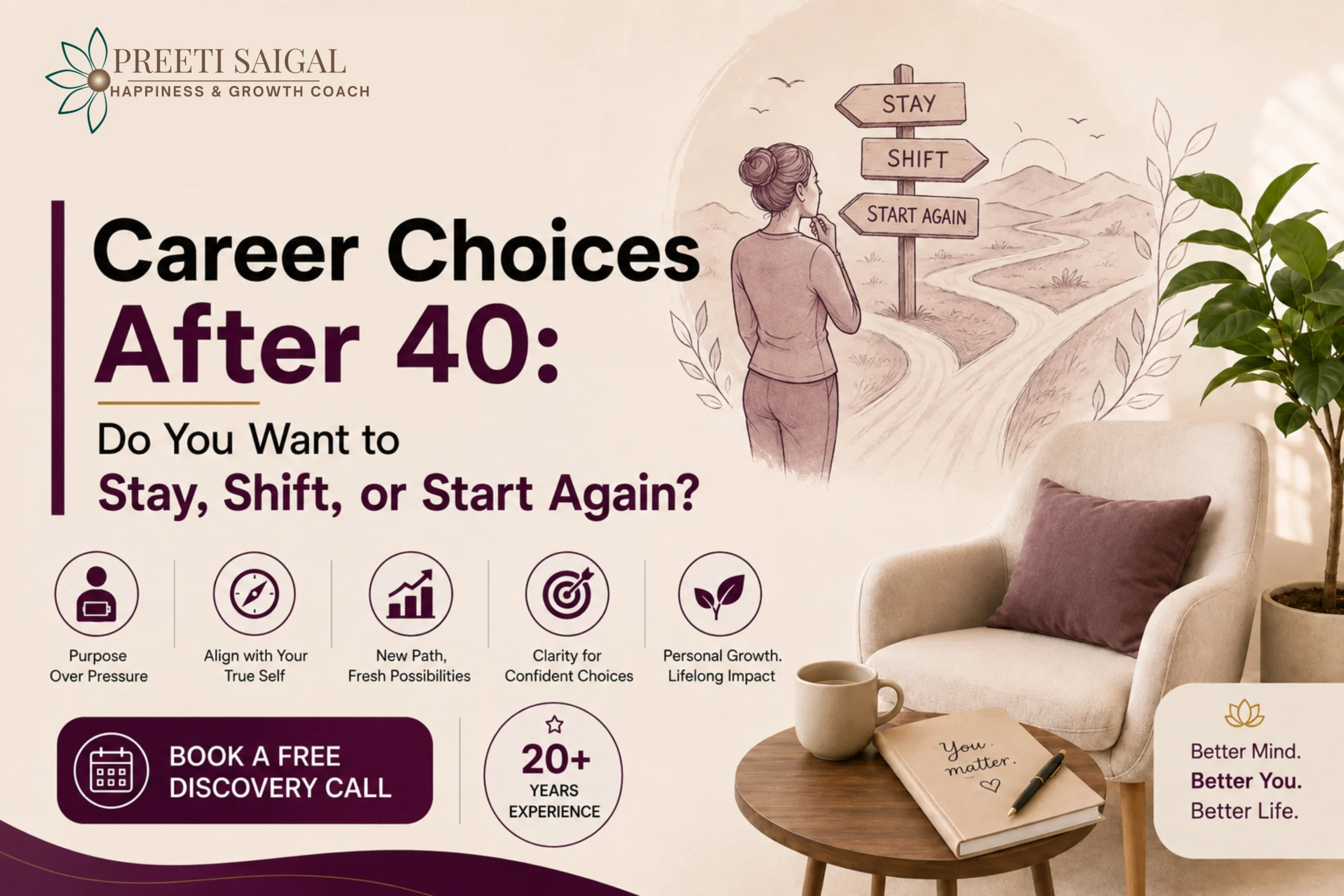
Career Choices After 40: Do You Want to Stay, Shift, or Start Again?
Something changes after forty. Not always suddenly. Not always dramatically. But many people begin to ask more honest questions about work.
Earlier, the focus may have been growth, money, stability, recognition, or proving yourself. But after forty, the questions often become more personal.
“Do I want to keep doing this for the next 15 or 20 years?”
“Am I staying because this still fits, or because change feels risky?”
This is why a career change at 40 is not always about leaving everything behind. Sometimes it is about changing how you work. Sometimes it is about shifting direction. Sometimes it is about starting something new. And sometimes it is about staying where you are, but in a healthier and more conscious way.
The real question is not always, “Should I quit?”
The better question is, “What choices do I actually have?”
What happens after 40?
By forty, many people have enough experience to know that success on paper does not always mean fulfilment inside.
You may have a stable job, a good income, a respectable role, and years of experience. Yet something may still feel off.
Maybe the work no longer challenges you.
Maybe the culture drains you.
Maybe you want more flexibility.
Maybe you want more meaning.
Maybe you are tired of carrying responsibility without enough joy.
Or maybe nothing is obviously “wrong”, but inside, you know this version of success no longer feels complete.
That does not mean your earlier choices were wrong. They may have been right for who you were then.
But they may not fully fit who you are now.
Stay, but change how you work
Sometimes you do not need a new career. You need a new relationship with your current career.
This may mean setting better boundaries, speaking up more clearly, asking for a role change, changing teams, reducing unnecessary responsibility, or no longer making yourself available for everything.
This option works when the career still has value, but the way you are functioning within it has become unhealthy.
The difficulty is that it requires you to change old patterns.
You may need to stop over-functioning.
You may need to say no.
You may need to ask for support.
You may need to tolerate disappointing people.
That is not easy, especially if your identity has been built around being capable, dependable, and always available.
But sometimes the career does not need to change first.
The pattern does.
If this feels familiar, you may also find this useful: Good Work Isn’t Enough: Why Speaking Up Drives Career Growth.
Shift into an adjacent path
Sometimes changing careers at 40 does not mean starting from zero. It means repositioning what you already know.
You may move from HR into coaching or organisational development.
From teaching into training or content creation.
From operations into consulting.
From sales into client strategy.
From corporate work into advisory or freelance work.
This kind of career transition at 40 allows you to carry your existing strengths into a new space.
The difficulty is self-doubt.
You may wonder, “Am I qualified enough?” or “Will people take me seriously?”
But you may already have transferable skills — communication, problem-solving, leadership, planning, client management, emotional maturity, and judgement.
The work is not to erase your past.
The work is to reframe it.
Start something of your own
For some people, the next chapter may be entrepreneurship, consulting, coaching, freelancing, or building an independent practice.
This can feel exciting because it gives you autonomy and ownership.
But it also brings uncertainty.
You may need to learn marketing, selling, pricing, networking, technology, and how to stay steady when results are slow.
The challenge is not only professional. It is emotional.
Can you stay confident without immediate validation?
Can you keep showing up while still learning?
Can you treat feedback as information, not failure?
This option should not be romanticised. But it should not be dismissed either.
Start small. Test the idea. Speak to people. Offer a pilot. Build proof. Learn what the market actually values.
A thoughtful experiment is often better than a dramatic leap.
Retrain for something new
Sometimes the desire is for a deeper change.
You may want to move into counselling, wellness, teaching, writing, design, healthcare, technology, social work, or another field that requires learning.
A career change at 40 with no experience can feel intimidating. But “no experience” usually means no direct experience in that field.
It does not mean you have nothing to offer.
You bring maturity, discipline, perspective, communication, resilience, and life experience.
The difficulty here is patience.
You may need a course, certification, supervised practice, portfolio, or a gradual transition. You may have to become a beginner again in some areas.
That can be uncomfortable.
But it can also be freeing.
Build a parallel path first
This is often the most practical way to start a new career at 40.
You do not leave everything immediately. You start building the next chapter alongside your current life.
You take a course.
You speak to people in the field.
You volunteer or consult part-time.
You create a portfolio.
You test your interest in real life.
This reduces risk because it gives you information before you make a big decision.
The difficulty is energy.
You may already be tired. So the aim is not to do everything at once. The aim is to build momentum without burning yourself out.
You do not need to have every answer before you begin. Sometimes you only need enough clarity to take the next step. I have written more about that here: You’ll Never Have All the Answers.
Every choice has a cost
People often stay stuck because they are waiting for a risk-free option.
But there may not be one.
If you stay, the cost may be regret.
If you leave, the cost may be uncertainty.
If you pivot, the cost may be discomfort.
If you start again, the cost may be time.
If you build slowly, the cost may be patience.
So the question is not, “Which option has no difficulty?”
The better question is:
That question moves you from panic to choice.
How to choose with more clarity
Before making any decision, ask yourself:
Ask yourself
- What is no longer working?
- What still works?
- What am I afraid of losing?
- What do I want more of?
- What do I want less of?
- What strengths do I want to use more fully?
- What responsibilities do I need to protect?
- What is the smallest experiment I can try before making a big move?
Also complete this sentence:
For example:
“I feel drained about my career when every day feels repetitive.”
“I feel anxious about my career when I imagine doing this for another ten years.”
“I feel unfulfilled about my career when my work has no visible impact.”
Clarity does not remove all fear.
But it reduces confusion.
How a coach can help you navigate career transition at 40
A coach does not make the choice for you.
A coach helps you see your choices more clearly.
That matters because when you are inside the problem, everything can feel tangled.
Fear can sound like logic.
Guilt can sound like responsibility.
Comfort can sound like practicality.
Impulsiveness can sound like courage.
A coach can help you slow down, separate these voices, and understand what kind of change is actually needed.
Sometimes you may realise you do not want a new career. You want stronger boundaries.
Sometimes you may realise you do not want to quit. You want to reposition yourself.
Sometimes you may see that the dream you keep postponing is possible, but it needs a better plan.
And sometimes, you may discover that the real block is not lack of skill, but lack of confidence.
Coaching can help you in three ways.
First, it helps you identify your choices.
Second, it helps you make the choice more consciously.
Third, it helps you navigate that choice with grace and confidence.
Grace does not mean the transition will be easy.
It means you do not have to move through it with panic, shame, or self-doubt at every step.
Confidence does not mean you know everything.
It means you trust yourself to learn, adapt, and keep going.
What I Bring as a Coach
Career decisions after 40 are about more than work. They often involve questions of identity, confidence, finances, family, and purpose.
As a Certified Happiness & Positive Psychology Coach with training in cognitive and hypnotic coaching, business mentoring, and personal growth, I combine practical career guidance with mindset support. With 20+ years of corporate and entrepreneurial experience, I understand the realities behind major career decisions.
I help you:
I help you
- Explore your options with greater clarity
- Identify what is really causing your dissatisfaction
- Recognise your strengths and transferable skills
- Work through self-doubt and fear
- Create a realistic plan for your next steps
My role is not to tell you what to do, but to help you make a decision that feels right for your life, values, and goals.
FAQs on Career Change at 40
Is it too late to change careers at 40?
No, it is not too late to change careers at 40. But it helps to plan carefully, understand your responsibilities, identify your transferable skills, and test your options before making a major move.
How do I start a new career at 40?
Start by understanding what is not working in your current career. Then identify whether you need a boundary reset, an adjacent shift, a new business, retraining, or a gradual parallel path.
What are the best careers to start at 40?
The best careers to start at 40 depend on your strengths, interests, lifestyle, and financial needs. Common options include coaching, consulting, training, HR, education, wellness, writing, entrepreneurship, and advisory work.
Can I make a career change at 40 with no experience?
Yes. You may not have direct experience in the new field, but you likely have transferable skills such as communication, leadership, planning, problem-solving, client management, or people skills.
How do I successfully change careers at 40?
A successful career transition at 40 usually requires clarity, research, skill-building, financial planning, small experiments, and emotional support. The goal is not to make a sudden leap, but to build a thoughtful bridge.
Final thoughts
At forty, the question is not always, “Should I change my career?”
Sometimes the question is:
You may choose to stay and work differently.
You may choose to shift.
You may choose to build something slowly.
You may choose to start again.
None of these choices is automatically right or wrong.
The right choice is the one you can make with honesty, responsibility, and self-respect.
You do not need to have the entire path figured out today.
You only need enough clarity to take the next step.
Book a Free Discovery Call
If you are at a career crossroads and unsure whether to stay, shift, or start again, you do not have to figure it out alone. Book a free discovery call to explore where you are, what feels stuck, and what your next steps could look like. Sometimes clarity begins with a simple conversation.